
Last updated September 10, 2026
Full 25-point door and opener safety check with every visit - springs, cables, rollers, tracks, and your LiftMaster or Chamberlain opener included
You get a price before we start. It does not change when the truck arrives.
 Before
 After
After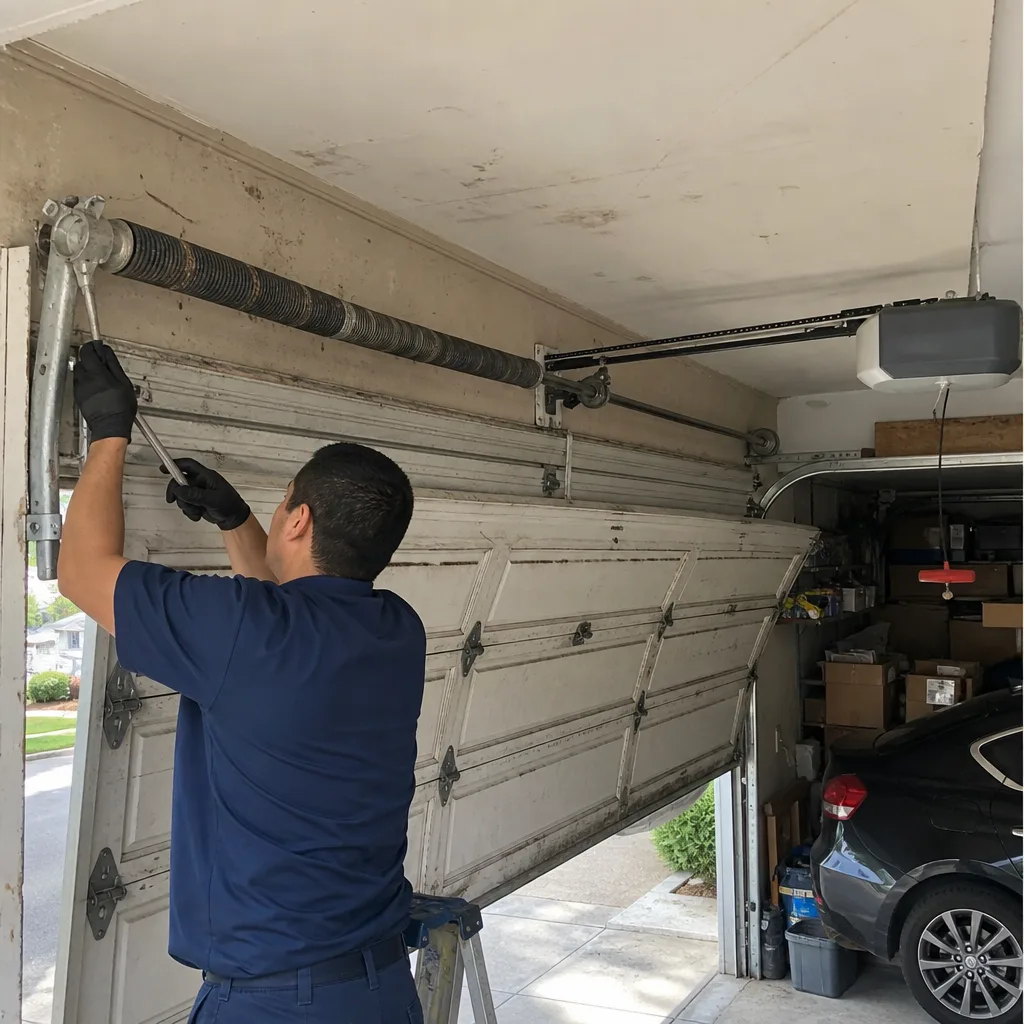 Before
 After
After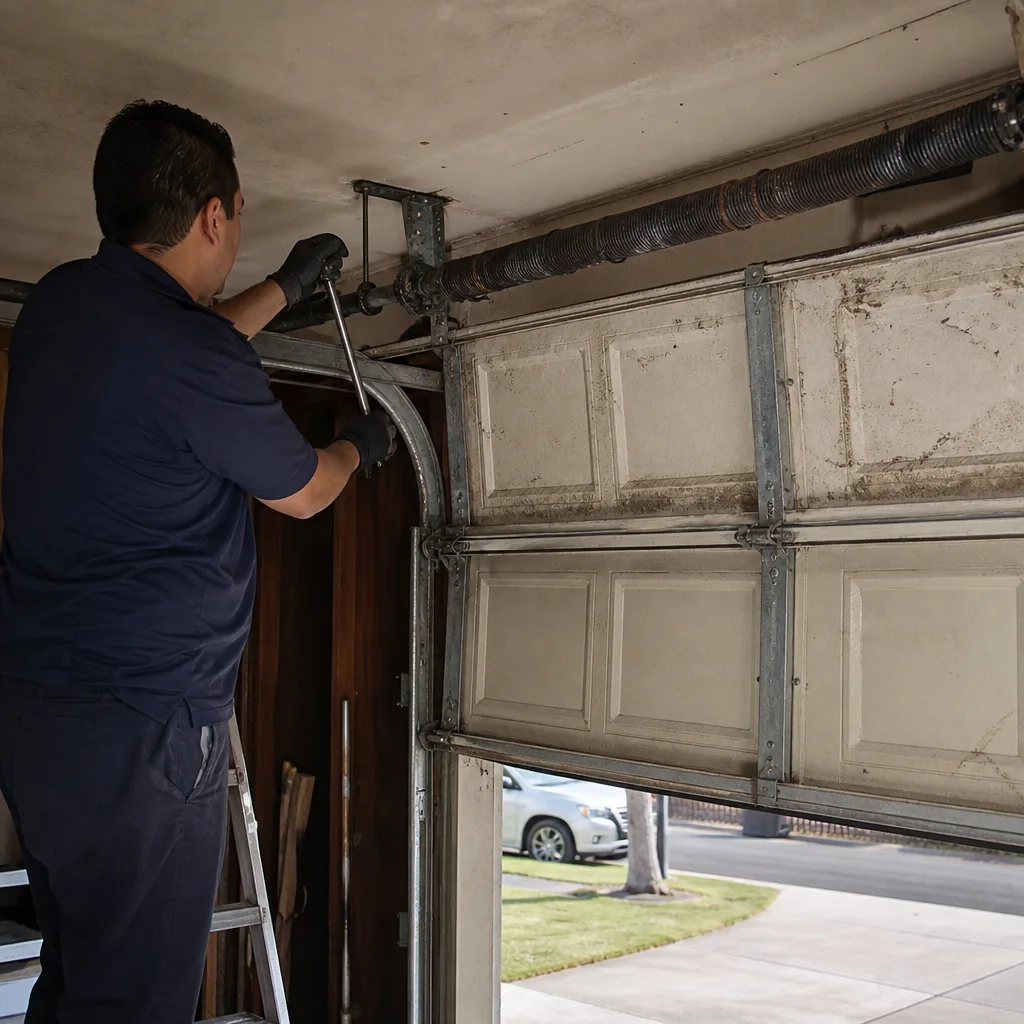 Before
 After
AfterDIY vs Professional Garage Door: The Cypress Homeowner’s Decision Guide
A standard torsion spring on a double garage door stores roughly the same energy as a .22 caliber rifle round. That’s not a figure we invented to scare you. It’s the physics of torque, and it’s why professional garage door associations consistently rank spring replacement among the highest-injury DIY tasks in home maintenance. In Cypress, where many homes were built during the 1970s and 1980s housing booms, we’re still seeing original springs and hardware that have cycled tens of thousands of times. This guide will show you which garage door tasks are genuinely worth doing yourself, which ones carry hidden dangers the YouTube tutorials don’t emphasize, and how to tell the difference before you’ve committed to either path. For more guides & resources, visit our blog.
Quick Answer
Most Cypress homeowners can safely handle lubrication, weatherstripping replacement, and photo-eye sensor cleaning themselves. Torsion spring work, cable replacement, and structural panel repairs should always be left to trained technicians. The dividing line is stored mechanical energy: if a failed component is under tension, the risk of serious injury outweighs any parts savings.
Table of Contents
- The Energy Problem: Why Some Garage Door Work Is Different
- What You Can Safely DIY in Cypress
- What Requires a Professional (And Why)
- The True Cost of DIY Spring Work
- The Warranty Fine Print Most Guides Skip
- How to Decide: A Task-by-Task Matrix
- Common Mistakes to Avoid
- When to Call a Professional
- Frequently Asked Questions
- The Bottom Line
The Energy Problem: Why Some Garage Door Work Is Different
Garage doors are counterweighted systems. The springs, whether torsion or extension, do the heavy lifting so your opener only needs to move about 10-15 pounds of dead weight. When those springs are wound and installed correctly, the door feels light. When they break or are removed improperly, that stored energy releases instantly.
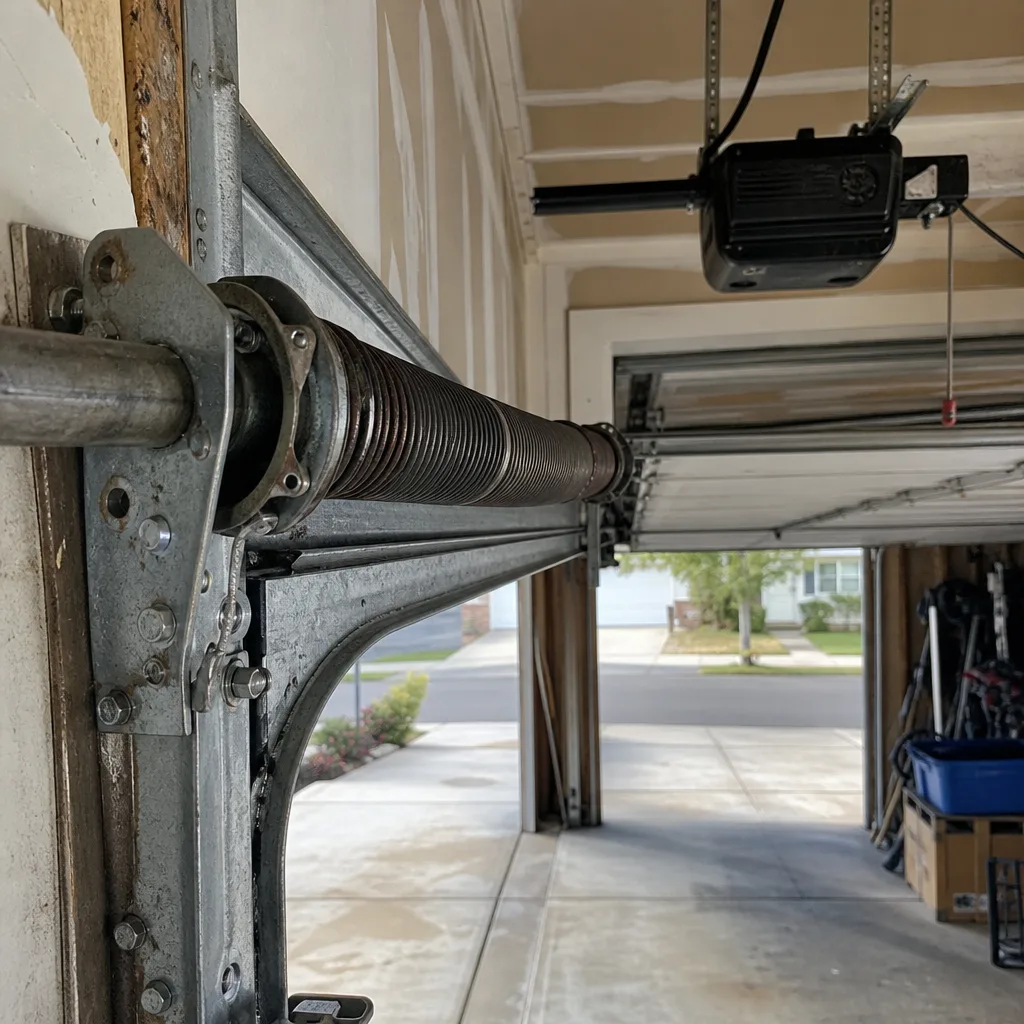
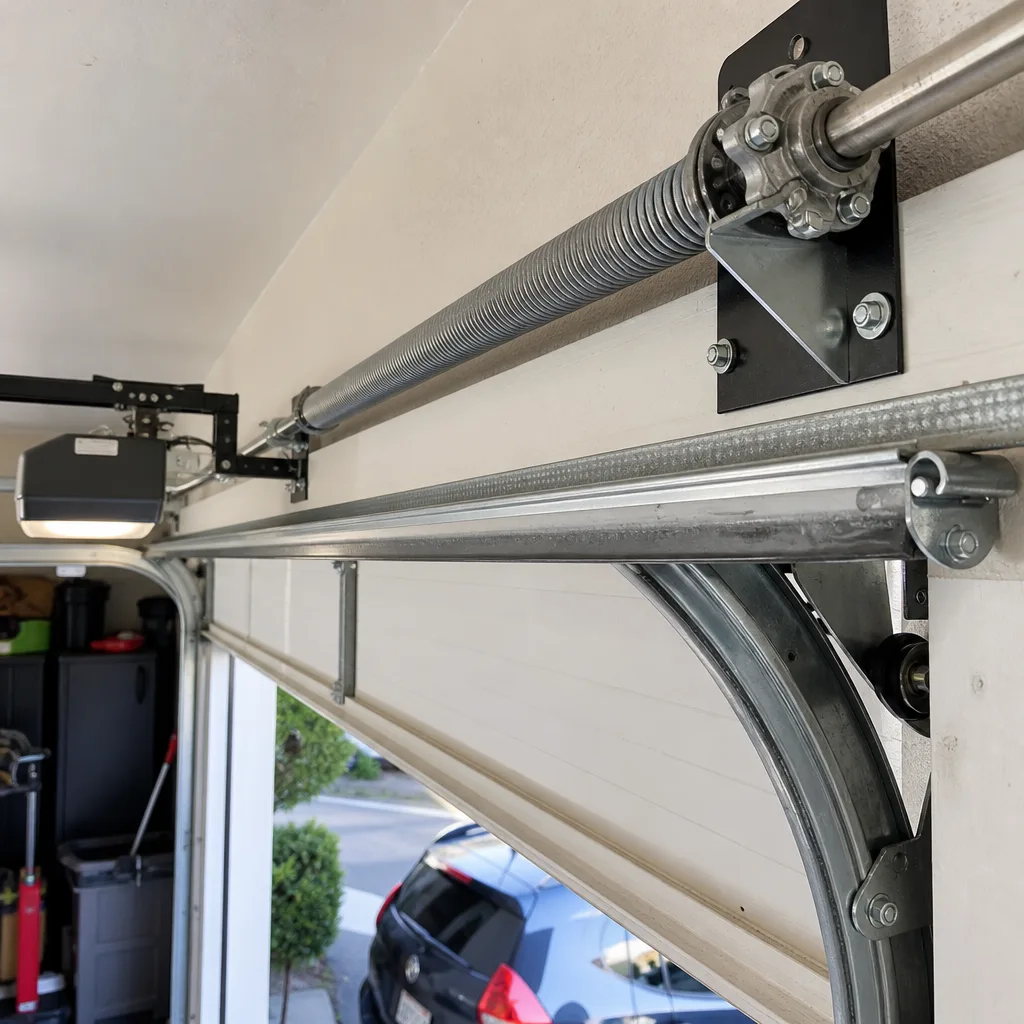
A typical residential torsion spring is wound to between 7,000 and 10,000 inch-pounds of torque. The winding bars used to add or release that tension are solid steel for a reason. We’ve seen bent bars, broken wrists, and lacerations from homeowners who watched a ten-minute video and thought they understood the procedure. The danger isn’t that the spring is complicated. It’s that the spring doesn’t give you a second chance.
Extension springs, common on older single-car doors in Cypress neighborhoods like College Park and the original tract homes near Katella, carry less total energy but present a different hazard. When they break, they can whip through the garage. The safety cables that run through extension springs exist specifically to contain this failure mode. If your extension springs lack safety cables, that’s a flag, not an invitation to add them yourself.
The honest frame for this decision is risk-adjusted time, not cost savings. A lubrication job takes twenty minutes and carries near-zero risk. A spring replacement takes a trained technician under an hour and carries significant risk for anyone without the proper bars, vise grips, and experience reading spring wind direction. The question isn’t whether you can afford a professional. It’s whether you can afford the downside if the DIY goes wrong.
What You Can Safely DIY in Cypress
Cypress homeowners can handle several maintenance and minor repair tasks without special tools or significant risk. The key is staying within tasks where no component is under meaningful tension.
1. Lubrication (Every 6 Months)
Silicone-based spray lubricant on the rollers, hinges, and bearing plates keeps everything quiet and reduces wear. Avoid WD-40 for this; it attracts dust and gums up over time. In Cypress, where Santa Ana winds carry fine dust from the nearby Coyote Creek flood control channel, dry lubricant can actually outperform wet formulations. Apply sparingly, wipe excess, and run the door up and down twice to distribute.
2. Weatherstripping Replacement
The bottom seal and side seals are held by retainer channels. Pull the old seal out, note the profile shape (T-end, bead-end, or bulb), and match it at a hardware store. This is a 30-minute job that improves energy efficiency and keeps water out during the winter storms that roll through Orange County.
3. Photo-Eye Sensor Alignment
When your door won’t close and the opener light flashes, the photo eyes are usually misaligned or dirty. Clean both lenses with a soft cloth, check that both LED indicators are solid (not blinking), and adjust the brackets until they face each other squarely. The sensors should be 6 inches or less from the floor per current safety standards.
4. Track Cleaning and Fastener Tightening
Wipe the vertical and horizontal tracks with a damp cloth to remove grease buildup and debris. Check that the lag bolts securing the track brackets to the jambs are tight. Do not attempt to bend or realign tracks yourself; if the door is binding, the track geometry is off, and that’s a professional job.
5. Remote and Keypad Battery Replacement
Simple, zero-risk maintenance. Most LiftMaster and Chamberlain remotes use CR2032 coin cells. Keypads typically use 9V batteries. If your opener uses MyQ technology, the wall console may need occasional battery replacement as well.
These tasks share a common feature: if you make a mistake, nothing releases stored energy. The door might be noisy, or the seal might leak, or the remote might not work. None of these outcomes put you in the emergency room.
What Requires a Professional (And Why)
Some tasks carry inherent mechanical danger that no amount of online research neutralizes. We group these by the specific hazard they present.
Torsion Spring Replacement
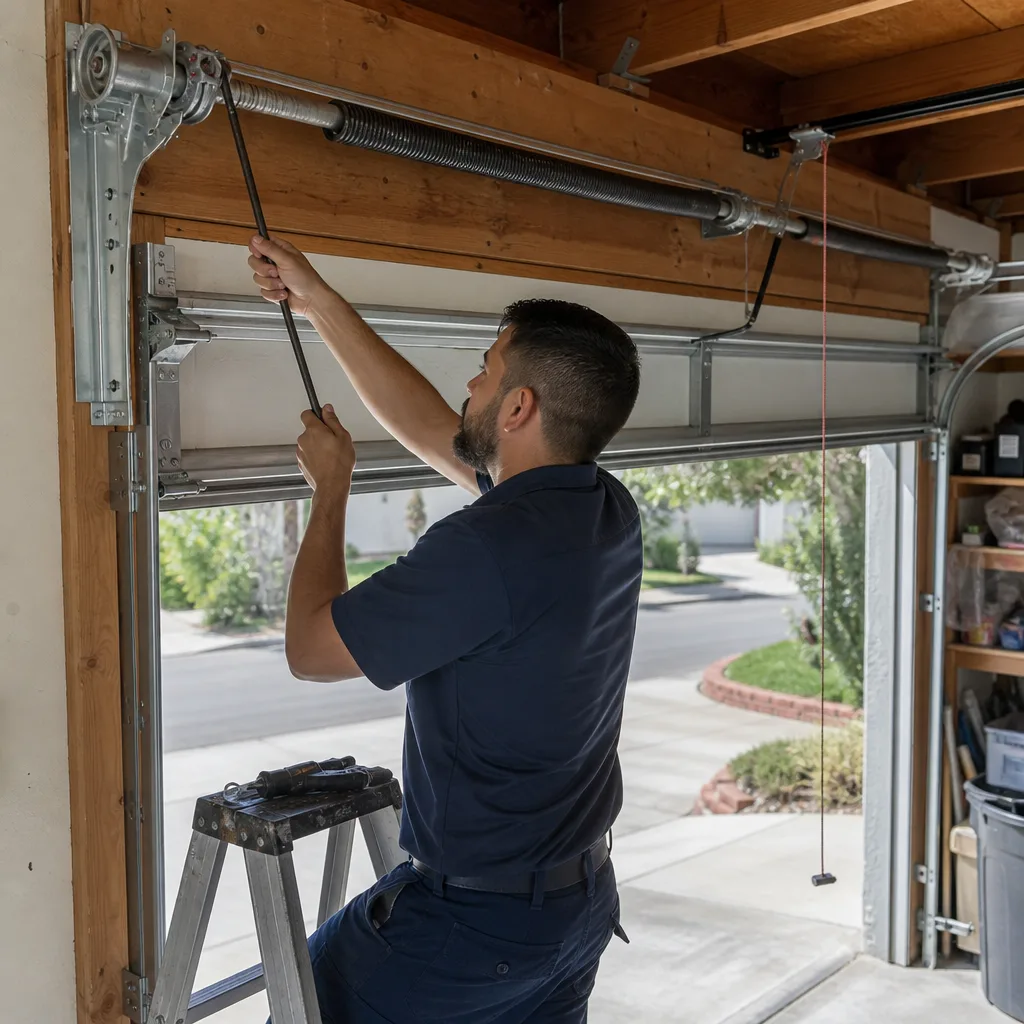
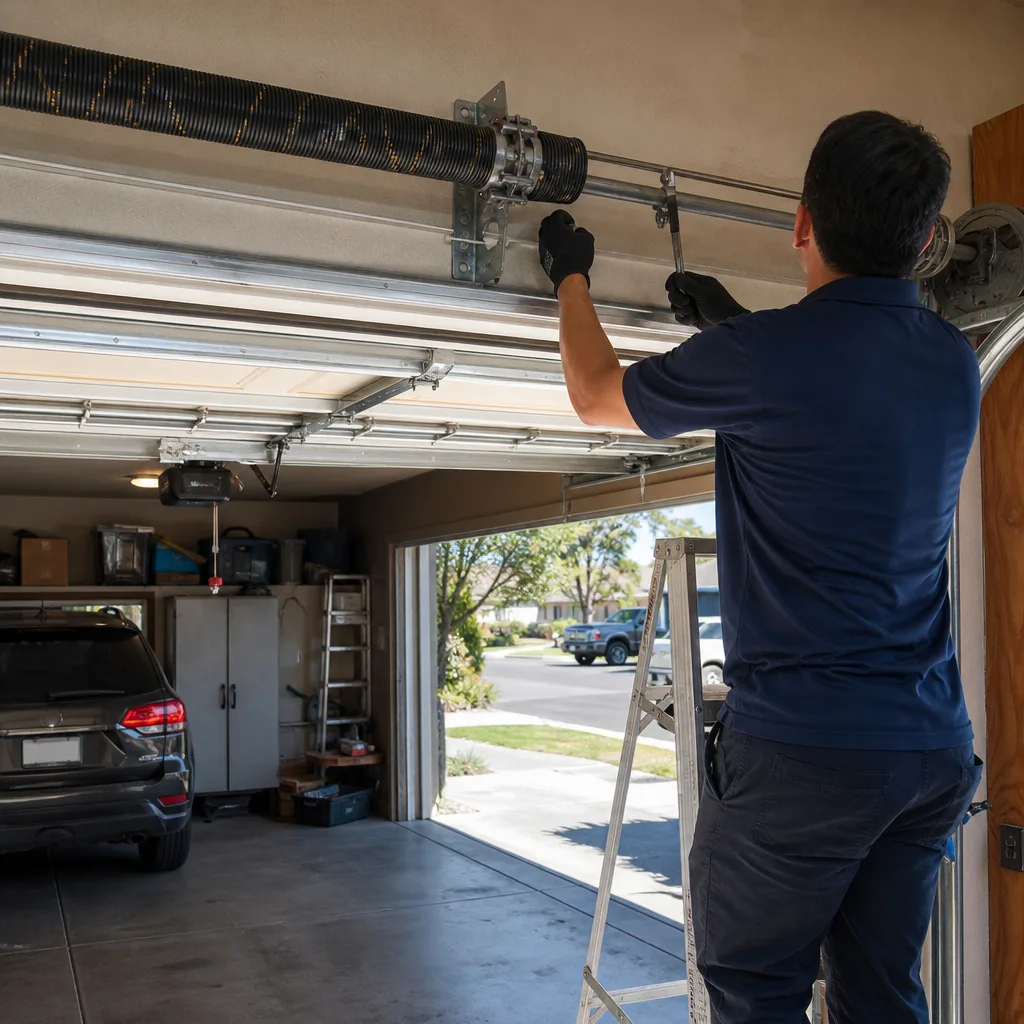
The winding cone on a torsion spring is under active torque during installation and removal. The winding bars must be inserted fully, held firmly, and moved in precise quarter-turn increments. A bar that slips or a cone that cracks can release the full spring energy in milliseconds. We’ve replaced springs in Cypress homes where the previous homeowner’s DIY attempt left the shaft bent, the cable drums damaged, and the door more expensive to fix than if they’d called initially.
Spring selection also requires matching wire gauge, inner diameter, and length to the door weight. An incorrectly specified spring will either fail prematurely or overstress the opener. We calculate this on every job, and we carry the full range of common sizes on our trucks.
Cable Replacement
Cables run from the bottom bracket to the cable drum, carrying the spring’s tension to the door. When a cable frays or breaks, the remaining cable holds unbalanced load. Bottom brackets are under tension even when the door is down. Removing a bottom bracket without relieving spring tension first is how fingers and hands get injured.
Structural Panel Replacement
Steel and aluminum door panels are structural members. A single panel replacement requires releasing the tension, disassembling the hinge connections, and rebalancing the door afterward. The new panel must match the gauge, profile, and insulation of the existing sections. Mismatched panels create binding and premature hardware wear.
Opener Mounting and Rail Assembly
The header bracket above the door carries the full reversing force of the opener. In Cypress homes with older framing, particularly the post-war bungalows near Lincoln Avenue, the header may need reinforcement before a modern opener can be safely mounted. A header bracket that pulls out drops the rail assembly onto the car or person below.
Bottom Bracket and Roller Replacement on Torsion Systems
These components are under cable tension at all times. The bracket itself is stamped with a warning label for a reason. This is not a bolt-swap operation.
The True Cost of DIY Spring Work
The internet will tell you a torsion spring costs $30-80 online. That’s true as far as it goes. Here’s the fuller accounting we think Cypress homeowners deserve. For a detailed breakdown of what to expect, see our Garage Door Cost Breakdown: The Cypress Homeowner’s Reference for 2026.
| Cost Component | DIY Path | Professional Path |
|---|---|---|
| Spring pair (typical double door) | $50-120 | Included in service |
| Winding bars (solid steel, 2 minimum) | $25-40 | Technician-supplied |
| Vise grips, wrenches, ladder if needed | $40-100 | Technician-supplied |
| Time investment | 3-6 hours first attempt | 45-90 minutes |
| Risk of injury requiring ER visit | Significant | Near-zero |
| Average ER visit cost (Orange County) | $1,200-3,500 | N/A |
| Follow-up repair for incorrect installation | $200-500 | Covered by warranty |
| Door or opener damage from wrong spring spec | $400-1,200 | Covered by warranty |
The honest math: even if you execute perfectly, your net savings on a single spring job is roughly $100-200 versus a professional repair. If you need the ER, you’ve lost thousands. If you specify the wrong spring and damage the opener, you’ve lost more than calling a professional would have cost. And if you value your time at even a modest rate, the DIY path rarely wins on economics alone.
Our garage door repair in Cypress includes spring replacement with the correct specification, full hardware inspection, and lubrication. Most jobs are completed in a single visit because our technicians arrive with springs, cables, and rollers already on the truck.
The Warranty Fine Print Most Guides Skip
Here’s a detail that doesn’t appear in the typical DIY-vs-pro comparison: doing your own adjustments can void equipment warranties in ways that matter financially.
Major opener manufacturers including LiftMaster, Chamberlain, and Genie specify in their warranty documents that damage caused by improper installation, adjustment, or maintenance is not covered. This isn’t theoretical. We’ve serviced Cypress homes where a homeowner’s self-adjusted travel limits caused the opener to strain against a binding door, burning out the motor. The manufacturer denied the warranty claim because the installation and adjustment were not performed by an authorized technician. For more on permit and code requirements, see Garage Door Permits, Codes & Inspections in CA: What You Need to Know.
The specific language varies by brand, but the pattern is consistent:
- Travel limit and force adjustments must be set to manufacturer specification using the specific test procedures in the manual
- Any modification to wiring, safety systems, or control boards voids the electronics warranty
- Damage from unbalanced doors or incorrect spring tension is excluded from motor and drive warranties
For Cypress homeowners with newer openers, particularly the belt-drive and wall-mount models that represent significant investment, this warranty exposure is real money. A $400-600 opener replacement that could have been covered becomes an out-of-pocket expense because the preceding adjustment was done without documentation.
The same principle applies to door panel warranties from Clopay, Amarr, and Wayne Dalton. Finish and structural warranties typically require professional installation. A self-installed panel that warps or delaminates may not be covered.
This doesn’t mean you can’t change your own remote batteries or clean your sensors. It means that when you cross into mechanical adjustment, you’re potentially trading a service call fee for the full replacement cost of equipment that would otherwise be under warranty.
How to Decide: A Task-by-Task Matrix
We’ve organized every common garage door task by risk level, tool requirement, and whether DIY makes practical sense for a Cypress homeowner. For a comprehensive maintenance schedule, see our Garage Door Repair Maintenance Checklist for Cypress Homeowners.
Green: Do It Yourself
| Task | Time | Tools Needed | Risk Level |
|---|---|---|---|
| Lubrication | 20 min | Silicone spray, rag | Minimal |
| Weatherstripping replacement | 30-45 min | Utility knife, tape measure | Minimal |
| Photo-eye cleaning and alignment | 15 min | Soft cloth, screwdriver | Minimal |
| Remote battery replacement | 5 min | Coin cell battery | None |
| Track cleaning and fastener check | 30 min | Wrench set, damp cloth | Minimal |
Yellow: Proceed with Caution (Know Your Limits)
| Task | Time | Tools Needed | Risk Level |
|---|---|---|---|
| Decorative hardware installation | 1 hour | Drill, level, measuring tape | Low (cosmetic only) |
| Window insert replacement | 45 min | Putty knife, silicone adhesive | Low |
| Keypad programming | 20 min | Owner’s manual, ladder | Low |
Red: Professional Required
| Task | Why Professional | Specific Hazard |
|---|---|---|
| Torsion spring replacement | Stored torque release | Laceration, fracture, head injury |
| Extension spring replacement without safety cables | Whip effect on failure | Impact injury, laceration |
| Cable replacement | Unbalanced load, tensioned bottom bracket | Crushing, amputation risk |
| Bottom bracket replacement | Constant cable tension | Severe hand/arm injury |
| Opener installation/mounting | Structural load, electrical, safety systems | Fall, electrical shock, door drop |
| Panel replacement (2+ panels or structural) | Tension release, rebalancing required | Crushing, improper reassembly |
| Track realignment or replacement | Precision geometry affects safety | Door derailment, binding |
The yellow category is where honest self-assessment matters. If you’re comfortable with basic tools and can follow a procedure precisely, these tasks are reasonable. If you’ve never used a drill level or find yourself improvising steps, move the task to red and call.
For any task in the red category, the question isn’t whether you’re capable in a general sense. It’s whether you have the specific tools, the specific experience, and the specific judgment to handle a component that can injure you before you can react. Most Cypress homeowners don’t, and there’s no shame in that. We’ve been training technicians for decades, and we still pair new journeymen with experienced leads on complex jobs.
Common Mistakes to Avoid
- Using the wrong lubricant on nylon rollers or the opener rail. Grease on nylon causes degradation; grease on a screw-drive rail attracts dust and hardens. In Cypress’s dry, dusty climate, this mistake shows up as noisy operation within weeks.
- Ignoring spring wind direction. Left-wound and right-wound springs are not interchangeable. Installing the wrong wind direction means the spring does nothing to counterbalance the door, and the opener carries full load until it fails.
- Disconnecting the opener without verifying the door is balanced. A door that crashes down when disconnected from the opener has a broken spring or cable. Homeowners sometimes disconnect to “troubleshoot” and create an immediate hazard.
- Adjusting travel limits to compensate for a mechanical problem. If the door won’t close fully, the limit adjustment is not the fix. Something is binding, a spring is weak, or a cable is off the drum. Moving the limits masks the problem until the opener or door fails catastrophically.
- Replacing one spring on a two-spring door. Springs age in pairs. The remaining old spring has different tension characteristics and will fail soon, often with more damage because the new spring is doing uneven work.
- Working alone on any task involving door movement. Even “safe” tasks become dangerous when a door slips off track or a ladder shifts. A second person is not optional for anything involving the door’s weight.
- Buying springs by door size instead of weight. A 16×7 door can weigh 150 pounds or 250 pounds depending on construction, insulation, and window count. Springs are specified by weight and cycle life, not dimensions.
When to Call a Professional
Call when the task involves tension, when the door is unbalanced, when you’re unsure of the specification, or when you’ve started and encountered resistance you didn’t expect. These are not failures of competence. They’re recognition that garage door systems are engineered with safety margins that assume professional installation and maintenance.
In Cypress, where many homes have original doors and hardware from the 1970s and 1980s, we also recommend professional evaluation when you’re unsure of the system’s history. A door that has cycled 50,000 times has different needs than one with 10,000 cycles. We can assess spring fatigue, cable wear, roller condition, and opener compatibility in a single visit.
Mainspring Garage Door Co. offers free estimates in Cypress. Call (626) 593-8187. Our technicians arrive with springs, cables, rollers, and openers on the truck, and we state the flat price before any work begins. If you’re unsure whether your task is green, yellow, or red, a phone call costs nothing and can save you from an expensive or injurious mistake.
Frequently Asked Questions
Professional torsion spring replacement in Cypress typically runs $180-340 for a standard residential double door, including both springs, cables if needed, and full hardware inspection. The exact price depends on door weight, spring specification, and whether additional components show wear. We state the flat price before any work begins, and our $50 off any repair over $250 applies to most spring jobs. Call (626) 593-8187 for an exact quote - estimates are free.
You can, but you shouldn’t. On a two-spring system, the remaining old spring has different tension and fatigue characteristics than a new spring. The imbalance stresses the opener, the door, and the new spring. We replace springs in matched pairs, and we warranty the work for 90 days. The small parts savings of a single spring isn’t worth the premature failure and potential damage.
It can. LiftMaster, Chamberlain, and Genie warranties exclude damage from improper installation or adjustment. If your self-adjusted travel limits burn out the motor, or your self-installed opener strains against an unbalanced door, the manufacturer may deny coverage. Professional installation and adjustment preserves your warranty documentation and protection.
Disconnect the opener by pulling the red release handle, then lift the door manually to waist height. A balanced door stays put. If it crashes down, the springs are weak or broken. If it rises on its own, the springs are over-wound. Either condition is unsafe and requires professional correction. Do not use the opener until the balance is restored.
Lubricate hinges, rollers, and bearing plates with silicone spray. Check weatherstripping for cracks that let in the cooler, wetter air of Orange County winter storms. Test the auto-reverse by placing a 2×4 flat on the threshold - the door should reverse on contact. Clean photo-eye lenses. These tasks take under an hour and prevent most cold-weather problems. If the door still binds or makes noise after maintenance, call for inspection before the weather turns.
Mainspring Garage Door Co. answers calls with a live person 24 hours a day, including nights, weekends, and holidays. Most emergency calls in Cypress are dispatched same-day, and our technicians arrive with parts to complete most repairs in a single visit. For spring failures, cable breaks, or doors off-track, we prioritize same-day response because a stuck door is a security and access issue. Call (626) 593-8187 - you’ll speak to a person, not a menu.
The Bottom Line
The DIY-vs-professional question for garage doors isn’t about capability in the abstract. It’s about matching the right resource to the right task. Lubrication, weatherstripping, sensor cleaning, and battery changes are sensible homeowner maintenance. Anything involving spring tension, cable load, or structural reassembly carries injury risk that outweighs modest parts savings.
In Cypress, where many homeowners have been in their homes for decades and plan to stay, the honest calculation is long-term: a professional repair done right, with correct parts, documented warranty protection, and a written guarantee of return if something isn’t perfect. That’s the standard we hold ourselves to at Mainspring Garage Door Co., and it’s the standard we think Cypress homeowners deserve.
Written by Carl Dutton, Owner at Mainspring Garage Door Co., serving Cypress since 2016.